Order As a Gift
“And my God will supply every need of yours according to his riches in glory in Christ Jesus.”—Phil. 4:19 (ESV)
This past June, I finished my career as a homeschool mom.
Needless to say, I’ve accumulated quite a bit over these past 23 years. Papers, projects, and of course—books.
It’s time to let them go. So I began going through them, figuring out what I can part with and what I still wanted to keep. After taking photos of beloved projects and scanning important papers, I started to clear out.
The hardest part, not surprisingly, was letting go of the books. For me, these are not neutral objects. They represent what I value, what I invested in, what I know and hope to know. Releasing them has felt, at moments, like losing a part of myself.
But here is what the process has been revealing: I was not holding onto my books for the people in my home. I was holding onto them for my own sense of security: the comfort of having information available, the reassurance that I could figure things out if I needed to. My books were serving me, not my household. And when I asked honestly whether they needed to stay, the answer, for more of them than I expected, was no.
That question—does this serve the people in this home, or does it serve my sense of security and identity?—turns out to be one of the most clarifying things you can ask about anything in your space. It reframes the entire project of ordering a home. Suddenly it is not about what you like, what “sparks joy,” or what fits a particular aesthetic. It is about people. Who lives here? Who enters here? What do they need from this space…and what are your things costing them?
Order As Love
If you think about it, a disordered space makes quiet demands on everyone inside it. How? It competes for attention. It reminds you of unfinished things.
It costs time as well. How much time do I spend hunting for what should be easy to find or managing the piles that have accumulated! (You know what I mean.) Disorder is never free. It extracts a toll from the people who live with it, often without our fully realizing it.
Order, by contrast, is a gift. Not because a tidy home is more impressive or means you’re a particular kind of person, but because it frees the people inside it.
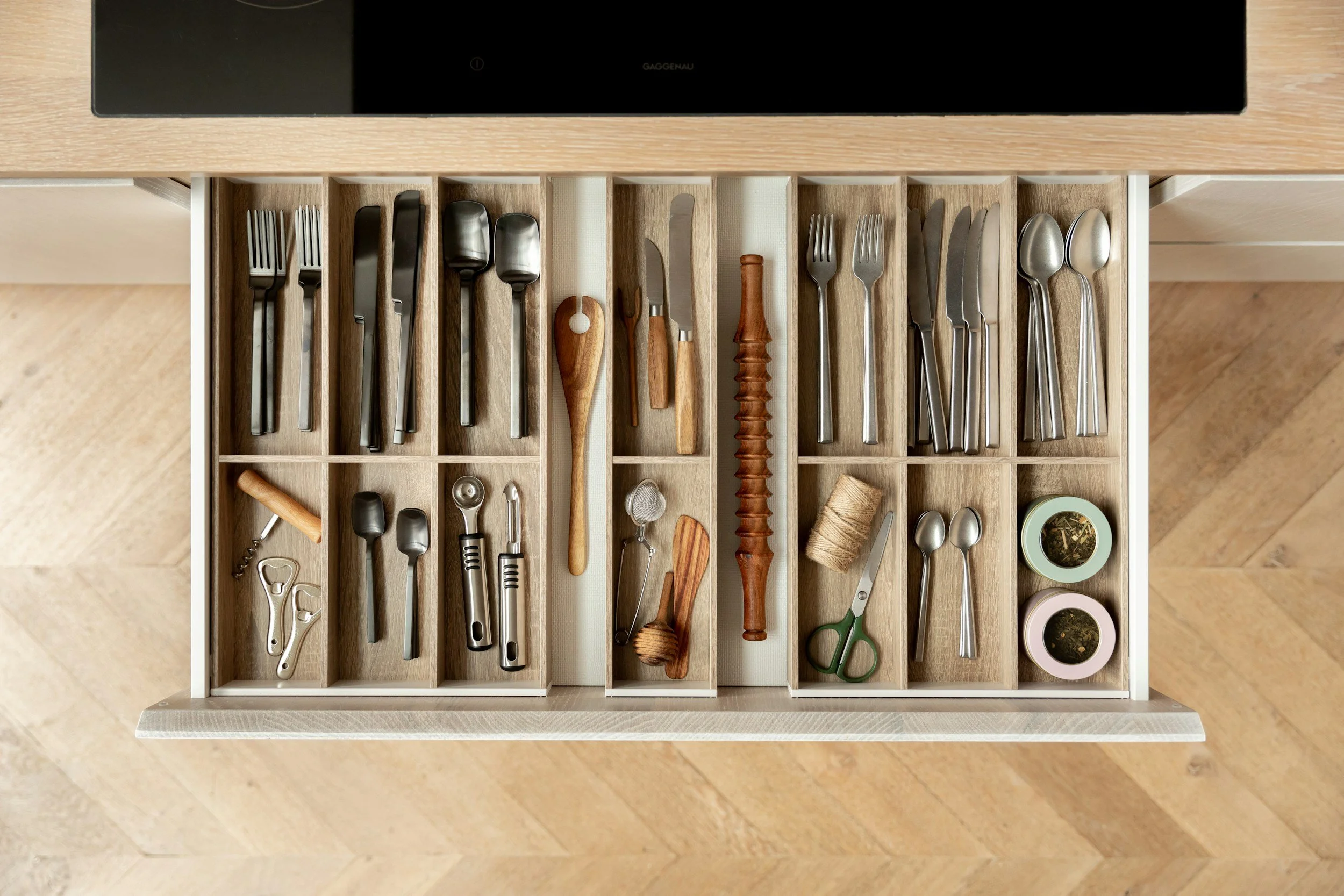
Take a look at the photo for this post. I chose it not just because it looks neat but because I have often spent so much time hunting for that pair of scissors that I know is somewhere around the house.
Likewise, my husband doesn't have to navigate around things that don't belong where they are. My guests can be attended to rather than apologized to. I am not spending my most alert hours hunting for files or reorganizing shelves that have overflowed again.
When the space is ordered, I can give what I actually have to give, which is not material: wisdom, attention, presence. I can be generous with what God has given me—and that has no shelf space requirements at all.
This is why approaching the ordering of a home as an act of love rather than an act of management changes everything about the motivation. You are not trying to achieve a standard. You are trying to free yourself and the people you love from unnecessary friction so we can rest, connect, and belong more easily in the space we share.
The Spiritual Logic of Letting Go
Clutter is rarely just clutter. The things I keep usually are tied to security, identity, possibility, memory, or the self I hope to become. For me, my books told me I was the kind of person who had resources, who was prepared, who could handle what came. Releasing them required trusting that the Lord who knows all things can supply what I need when I need it (Phil. 4:19), that I do not have to be my own library to be useful to the people in my life.
This is the spiritual logic underneath the practical project: letting go is an act of trust. It reminds me I do not need to secure myself with things because when my home is in the Lord, my heart is full of good things to give away.
It says the most important things I have to give—like my attention, wisdom, presence, and love—cannot be stored on a shelf or lost in a move. They are given and renewed by God himself, which means they are always available regardless of what I have managed to keep.
As I have remembered that what God has given me in my years of homeschooling is not in a curriculum that is soon outdated and replaced with something new but wisdom that can not be taken from me, I have been able to let these go more readily. In fact, it has been one of the most satisfying and joyful experiences—to put my books into the hands of a new homeschooling mom and blessing her with them. As I release what has served its purpose in my life so that it can serve someone else, I am actually freeing up space for God to fill my heart with something more to give away.
Simplicity, understood this way, is contentment made visible. Orderliness can be beauty without a hefty price tag. It brings a restfulness without words.
Let’s be clear, however: I’m not advocating minimalism, the lifestyle ideology that finds virtue in having less for its own sake. The Bible’s concern about material wealth is never square footage or aesthetic clarity but the heart's relationship to what it holds. The question is not how little you can live with but whether what you have is serving your love for God and people or competing with it.
Order In a Small Space
This is especially important when your home is small. In a small space there is no room to absorb that accumulation. What a larger home can hide in a spare bedroom or an overflow closet, a small home puts immediately on display.
This feels like a disadvantage until you realize it is actually a clarifying gift. The constraint forces the question earlier and more honestly: what do we actually need here? What truly serves the people in this space? What can be released?
I have found that these decisions, made honestly, actually can work to my advantage. Instead of focusing on deprivation, they help me to focus.
When I have less to manage I can spend more time with people. When there’s less to look at, there’s also less noise demanding attention. With less to maintain, I can have more energy for what actually matters. A small home does not just tolerate simplicity: it can also teach contentment in the things that really matter…if you are willing to be taught.
And what remains, when you have asked the honest questions and released what needed to go, is not an empty space. It is a ready one, one ordered in service of the people who live there and the people who will come through the door. It is clear enough to welcome them without apology and simple enough to let them actually rest when they arrive.
That is the gift. And it costs nothing to give except the willingness to let go of what was never really serving anyone in the first place.
From My Home to Yours
Choose one category of things in your home—books, files, kitchen items, linens—and apply the diagnostic question: does this serve the people in my home, or does it serve my sense of security or identity? You do not have to act on the answer today. Just think about what it reveals of your heart.