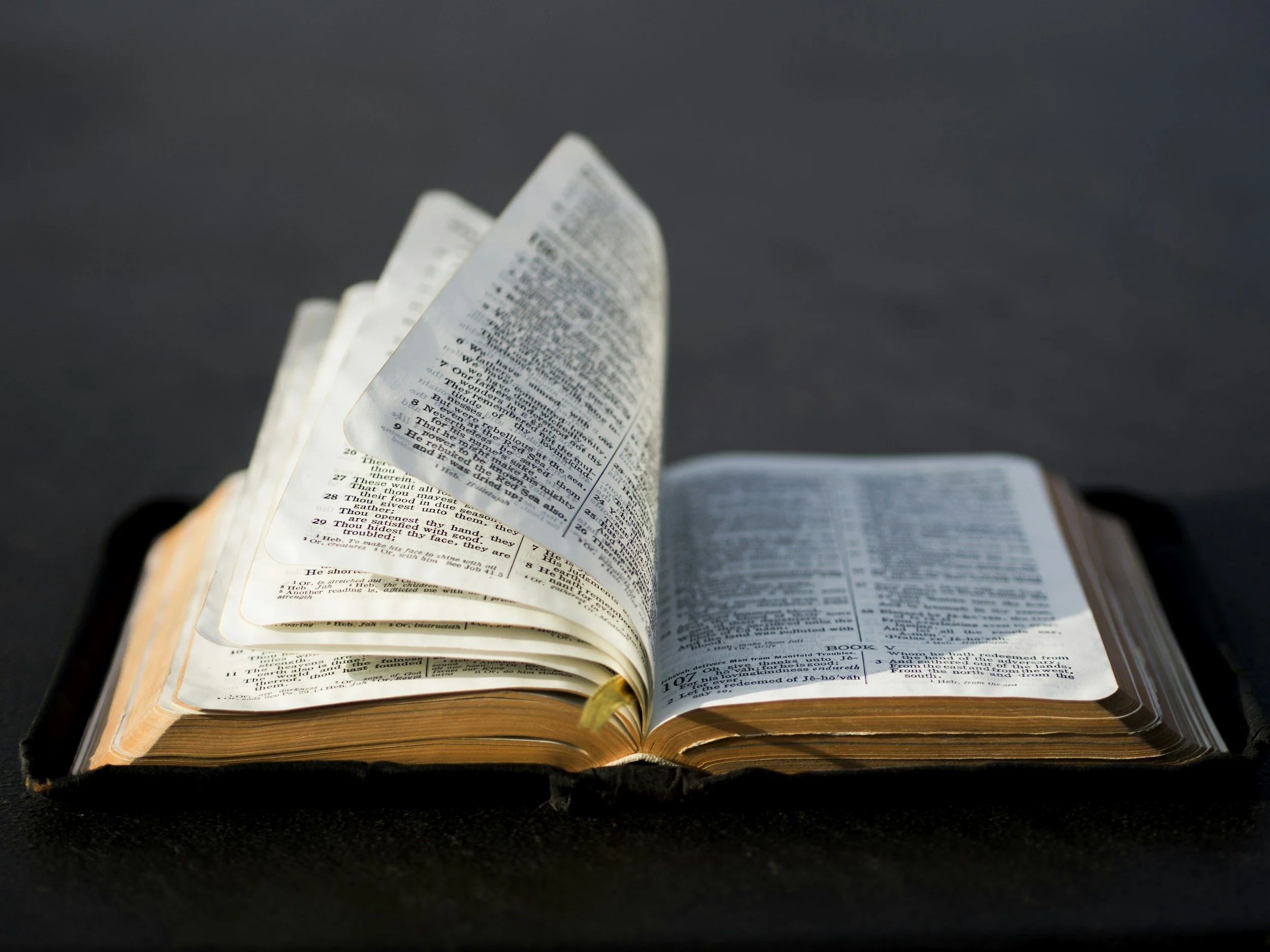
A Whole Bible for a Whole Life
"The sum of your word is truth, and every one of your righteous rules endures forever."—Psalm 119:160 (ESV)
Being a faithful servant of Christ requires that we both have solid Bible study skills but a strong sense of context and Story as well. This helps me to empathize with others as they struggle with the effects of sin. However, knowing the Story also helps me to point our eyes back to Christ. Because He has come, those who trust Him can live differently and not just as the world lives.
The Whole Bible
Before we move on, I wanted to highlight two key skills that Emlet discusses in chapter 4 of CrossTalk: learning to read front to back and back to front. This “bidirectional reading” helps us to both zoom in to the details and zoom out for perspective. As we alternate between these two skills, we then hear the particular voices and themes of individual books but also see how they fit into the Bible as a progressive unfolding of God’s redemption as a whole.
Reading Front to Back
To read the Bible front to back, we need to consider what this passage meant to the original recipients first—not to us. That requires taking the time to put ourselves in their shoes, with the limits of their understanding. For example, Adam and Eve would not have the benefits of knowing about Abraham or David, much less Jesus. David could only trust that he would have a descendant one day who would sit on the throne forever.
When I take the time to think about when a psalm was written or a parable was spoken or an epistle was read, this helps me to better appreciate its purpose. It keeps me from importing my own understanding, in my culture and situation, into what God says. Reading front to back helps me to better appreciate why God saw fit to reveal himself in this portion of Scripture at this time for these people. Knowing what it meant to them impacts my application and how I step into the story today.
If climax of the Story is Christ, then every Old Testament passage will anticipate him—even if tangentially. Likewise, every New Testament passage will flow out of His work on the cross. We don’t need to “shoehorn” him into every text, as Emlet ponts out, but it will flavor our understanding of it and the understanding of his kingdom.
That means details matter. I notice this as I love to read mysteries. The angle the glass is cut. The type of ash in the fireplace. The depth of a footprint or the length of a stride. These details lead somewhere and are important in and of themselves. I’m not saying every detail does mean something, but at the same time, assuming they don’t mean anything means that we can lose much of the depth and understanding of a passage.
If we’re living in Act 5 and looking forward to Act 6, this helps us keep in mind that the Spirit is now at work towards that end—and that colors how we understand our lives today—and how we live and the kind of counsel we give. This gives great purpose to how we live faithfully today—it may not seem to make sense now, but it makes a whole lot of difference later.
Reading Back to Front
Just as keeping a character’s situation in mind is helpful, so is knowing the ending. I totally appreciated Emlet’s example of reading the Harry Potter series. The details that once were insignificant now play a part in the final resolution of the story. The actions of one character in book 2 set in motion a path that counted and helped later.
When we know the ending, we can then go back to scenes we overlooked previously and see them in a new light after we know the ending. Specifically, for readers of the Bible, this means we need to consider how the reality of Christ’s life, death and resurrection, to promise of new creation, and the ultimate ending of the Story—Christ’s return to reign and rule forever in the new heaven and the earth as sole and victorious king—will change how we understand any Bible passage.
This means that knowing the climax of the story will help me see that every genealogy, dietary law, and prophetic utterance lends its voice to this Story. I may not use them directly in my counsel to others (they’re not quite “psalms, hymns, and spiritual songs”!) but they do inform me.
As I’ve learned to understand the pinnacle of Christ’s coming and work in the Story, I have found myself looking back on these once-confusing passages in a new light. I’ve even become interested in studying Leviticus for that reason! As my appreciation for these passages grow, I am slowly learning to be more comfortable with them and appreciate them more. It’s not always easy, but the fruit of it has been rich.
The Whole Life
Reading Scripture is not just about knowing more facts about it or about God or about how to fix the problems I see. As I saturate myself in His Word, my vision for life is enlarged. As I understand His Word and His Story, I discover a new purpose and reason for pursuing God in the midst of it. As I study and grow, I learn how to view my struggles and the challenge to obey in the midst of them as an opportunity for him to renew my thinking, living, and relating.
Though the canon of Scripture is closed, God’s Story continues. My life—your life—is part of it. This means my life is going somewhere, moving towards an end, makes all the little pieces of my life fill with purpose. I might not always see it, but I trust that it is. That means every small and unnoticed act of service for our disabled daughter, every faithful post I write for this blog, every time I sacrifice my desires for the greater good of God and others—all these “count” for the kingdom because my understanding of Scripture as a whole story means I fit in that story too.
As I internalize this and this perspective pervades my own outlook, this changes how I see others’ issues as well. It radically changes how I listen and help others. I’ve noticed that it’s now less of a survival mentality but a growth perspective. My job is not to hear “trigger words” and dump all we know about that topic on them. It’s a bit more nuanced than that.
I’ll stop here for now, but in the posts to come, we’ll move from reading Scripture to “reading people”—another skill that is just as vital. If we can also do this well, we are then able to bring that bit of God’s Word they most need to hear in their particular circumstances—words fit for their situation: apples of gold (Prov. 25:11), words seasoned with salt (Col. 4:6) that spread the fragrance of the knowledge of Christ (2 Cor. 2:14).